Veterinary Dental Center

Root Canal Therapy of a fracture mandibular molar


Root Canal Therapy for PetsTeeth are subject to fracture or trauma in daily play and forceful chewing. Superficial fractures benefit from radiographic evaluation of the root, smoothing any rough edges and in many instances sealing of the exposed dentin to relieve pain. When the pulp is exposed the tooth will die and infection will extend to the apex (root tip).

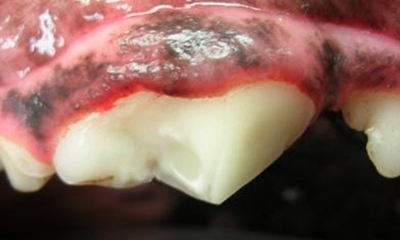
This patient has a fracture of the right mandibular first molar with pulp exposure (arrow). The fracture is relatively recent in that the pulp is red in color whereas an older fracture (months) will have a black pulp indicating pulp death. Intra-oral radiographs are used to confirm that the tooth is a good candidate for root canal therapy. Radiographs allow evaluation of the root(s) for fractures, stenotic canals or tooth abscess. The lower first molar is a large double rooted tooth that is important in chewing.

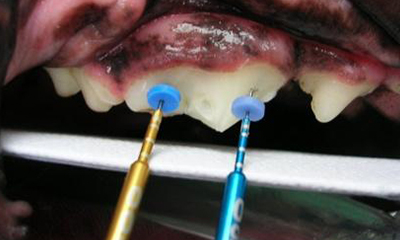
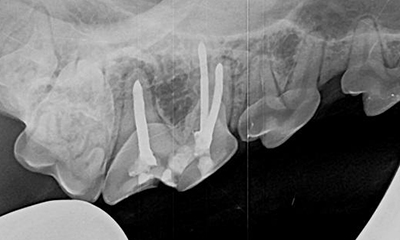
Access holes are made with a round bur at predetermined points on the tooth (arrows). This allows straight-line access down the root canal to the apex. A series of files are used to clean and shape the canal. Radiographs guide this process. The files are pre-measured and marked with a rubber stop to prevent extending beyond the apex. The goal is to remove all the diseased pulp tissue and to enlarge the canal to the apex. An antiseptic irrigating solution and chelating agent are used throughout the filing process to accomplish this. After the canals have been meticously cleaned, they are sealed with a cement and filled with an inert material.

We use a heated gutta percha system, Successfil, to attain the best apical seal. In this system, small amounts of Successfil are introduced into the canal. It is firmly compacted. The canal is gradually filled this way to minimize voids and seal it.

Once the tooth is filled it is ready for a two-layer restoration of the crown. The first layer is a glass ionomer resin. Glass ionomer's offer an excellent bond to the inside walls of the tooth and are antibacterial as they release fluoride. The final layer is a hybrid composite resin. This product is very durable and will resist wear. Composites are the same color as the tooth and are polished smooth.

Digital pictures are sent home with the pet owner to allow them to watch the restorative sites for any changes. Follow-up radiographs are recommended in 6 months.